The iGaming industry is one of the most technologically complex and regulated development segments. A modern iGaming platform (online casino, betting platform or poker room) is a huge distributed ecosystem. It must simultaneously process thousands of gaming sessions per second, calculate complex betting combinations in real time, ensure absolute computational fairness (RNG) and ensure smooth payouts.
At MonoSoftware we design iGaming systems using a modular microservice approach. In this article, we analyze the internal structure of the platforms: from Player Account Management (PAM) to the integration of game providers and financial gateways.
1. Anatomy of an iGaming platform: key modules
Any scalable platform consists of five fundamental blocks that operate in isolation from each other to ensure fault tolerance.
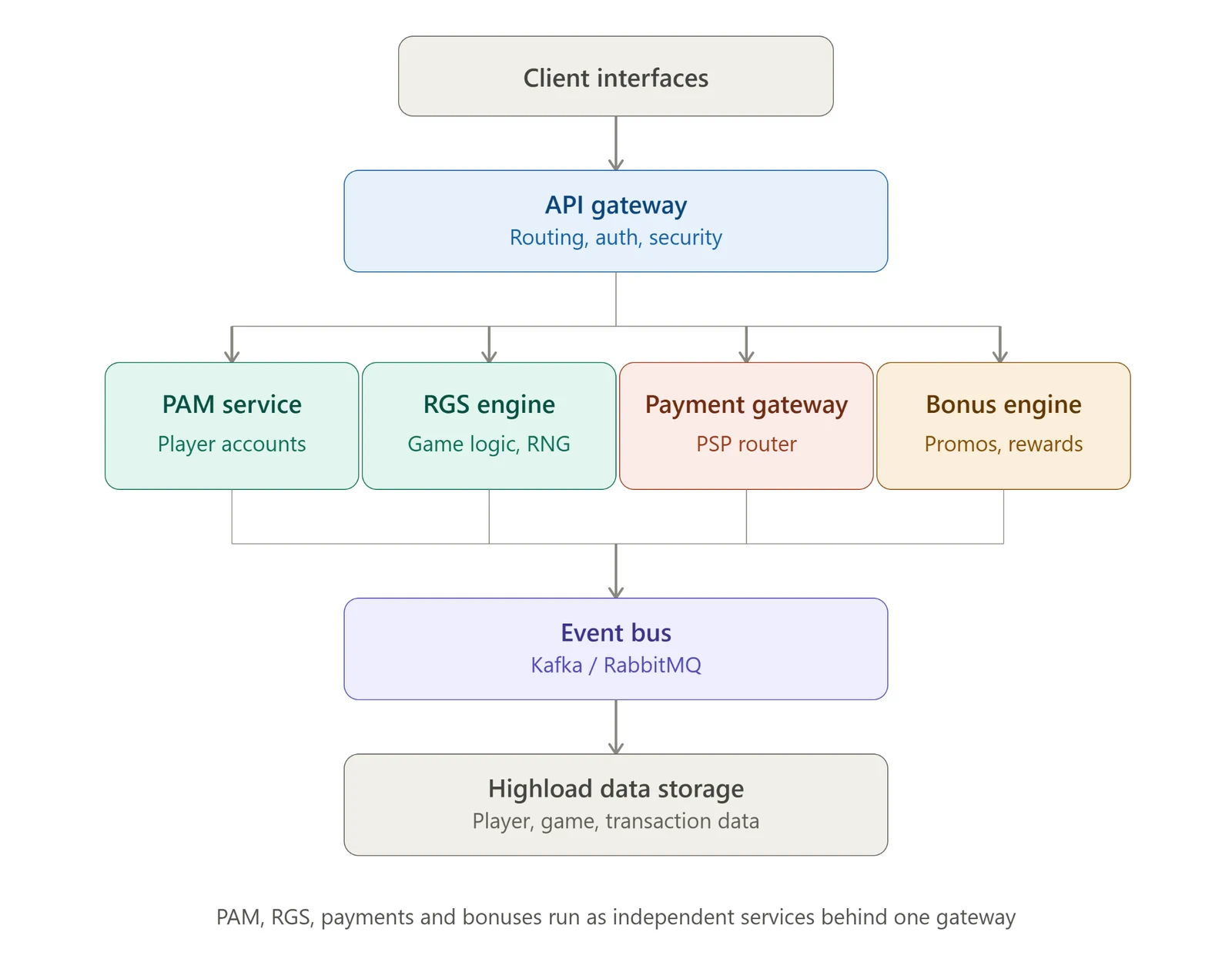
A. PAM (Player Account Management) - the core of the platform
The PAM service is responsible for managing the player's lifecycle. It aggregates profiles, balances, financial history, verification statuses (KYC/AML) and Responsible Gaming limits.
- Requirement: High level of isolation. Changing the player’s balance must occur within the framework of transactions with atomic locks (ACID compliance) to avoid “double-spending” (double debiting or crediting of funds).
B. RGS (Remote Game Server) and Game Engine
Game engine that provides mathematics and logic for game rounds (slots, roulette, crash games).
- Random Number Generator (RNG): An algorithmic engine that generates random outcomes. In genuine iGaming systems, RNG is validated by independent laboratories (GLI, iTech Labs).
- Round states: The engine should save intermediate game states (Game State) in case the client's connection is lost, so that after reconnecting the player continues from the same second.
Q. Seamless Wallet API and game aggregators
- Operators connect providers (Pragmatic Play, Evolution, Spribe) via the Seamless Wallet protocol. The balance is stored exclusively in the platform's PAM. With each rotation of the reel (spin), the provider makes a quick request (Debit / Credit). The acceptable server response time is less than 100-150 ms.
2. Real time and game event processing
In betting and live gaming, minimal data transfer latency is critical. Using regular HTTP REST APIs results in unacceptable latency.
- WebSockets / gRPC: To broadcast changes in odds in live bets or display the growth of the multiplier in Crash games, a duplex connection via WebSockets with the binary Protobuf protocol (gRPC) is used. This reduces network overhead by 5-10 times compared to JSON.
- Event-Driven Architecture: All actions within the game are turned into events sent to Apache Kafka. The analytics module, anti-fraud module and promotional services react to these events asynchronously, without delaying the main gameplay.
3. Payment infrastructure and cascade router (PSP Router)
Payments and deposits are the main artery of the iGaming business. Dependence on one acquirer or payment provider is critical: if the payment system fails, the conversion to deposit drops to zero.
At MonoSoftware we create cascading payment gateways (Smart Payment Routing):
- Fallback: If payment gateway A rejects a transaction or is temporarily unavailable, the system automatically and seamlessly redirects the payment through gateway B or C.
- Dynamic router: Select a payment provider based on the player's geo-location, currency, card type, total gateway conversions at the moment and commission.
- Automatic reconciliation (Reconciliation): Background workers 24/7 compare internal platform logs with registers of statements from payment providers to identify discrepancies and stuck transactions.
4. Comparison of approaches to the architecture of iGaming platforms
| Parameter | Monolithic Platform (Legacy) | Microservices Architecture (MonoSoftware) |
|---|---|---|
| Seamless API response time | 300–600 ms (risk of provider timeouts) | 50–120 ms (due to database isolation and caching in Redis) |
| Adding providers | Requires rebuilding of entire platform | Connected by a separate microservice adapter without downtime |
| Scalability | Limited by the capacity of one server | Independent horizontal scaling of game servers |
| Fault Tolerance | A database crash causes all services to stop | If the analytics or promotional module crashes, the games continue to work |
5. Checklist for iGaming platform compliance with industry standards
- RNG Certification: The random number generator code is isolated and prepared for testing to obtain GLI-19 / GLI-19 Compliance certifications.
- Seamless Wallet response: The backend can withstand the load of processing financial commands from games in < 100 ms at 10,000+ RPS.
- Logging and Audit Trail: Every bet, win, credit and balance change is logged into an Append-only storage for regulators.
- Antifraud on withdrawals: Rules for automatic verification of winnings have been configured (checking the wager, checking the IP/device match when depositing and withdrawing).