When introducing a mobile product to the FinTech, Web3 or iGaming market, founders and CTOs face a classic dilemma: develop two independent native applications (Swift for iOS and Kotlin for Android) or choose a cross-platform framework (Flutter).
On the one hand, the market requires maximum launch speed (Time-to-Market) and budget optimization. On the other hand, applications in the financial and gaming sectors have strict requirements for security, processing speed of financial transactions, and work with animated interfaces and hardware modules of devices.
At MonoSoftware we design and develop mobile services on both stacks. In this article, we compare the native approach and Flutter in detail, debunk myths about productivity and provide a clear decision-making matrix for business.
1. Main criteria for choosing a stack for High-risk and Highload services
Mobile applications in FinTech and iGaming are significantly different from standard E-commerce or content services. Three factors come to the fore here:
- Data security and anti-fraud: Working with cryptography, protection against code decompilation, Root/Jailbreak detection, secure key storage and biometric authentication.
- UI rendering speed (FPS): In iGaming and trading applications, the user interacts with complex charts, Live win animations and a constant stream of updates via WebSockets. Frame drops catastrophically reduce conversions.
- Time-to-Market and cost of ownership: How quickly the team can roll out the same functionality and fixes on both platforms (iOS and Android).
2. Flutter Architecture: Why It's No Longer \\\\\\\"Just Cross-Platform\\\\\\\"
Early cross-platform technologies (React Native, Cordova, Ionic) used JS Bridges or WebViews, which created performance problems. Flutter works on a fundamentally different principle:
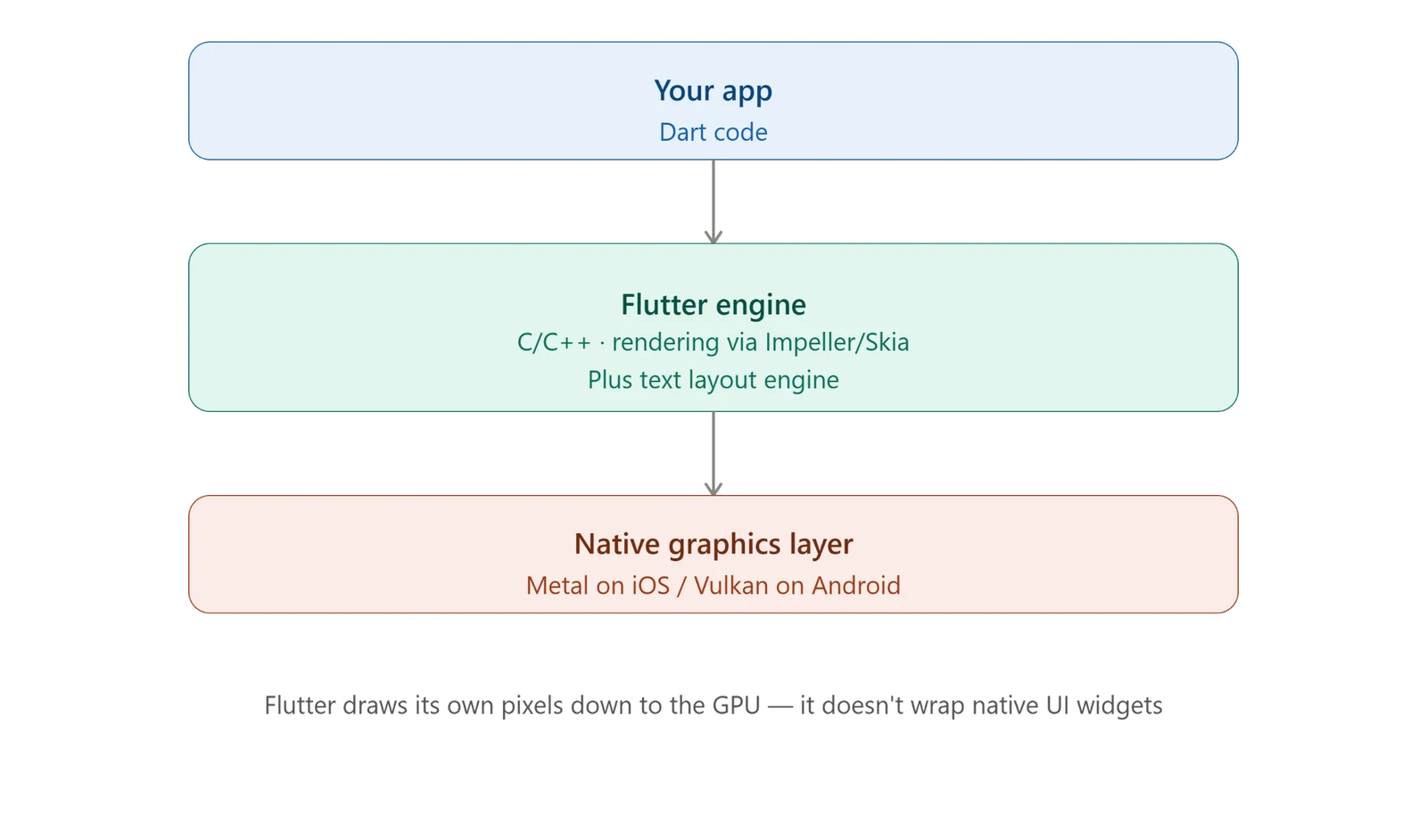
- Native rendering engine: Flutter does not use native OS UI components. It renders each pixel independently using the Impeller/Skia render engine directly on the graphics processing unit (GPU) via Metal or Vulkan. This guarantees a fair 60-120 FPS even with complex 2D animation.
- Compilation to machine code (AOT): Dart code is compiled directly to native ARM machine code for iOS and Android, eliminating interpreter overhead.
3. Comparison of approaches in the context of FinTech and iGaming
Important: Choosing between Flutter and Native is not a conversation about “which is better in general,” but an assessment of the balance of cost, timing and technological risks for a specific phase of your product.
A. Security and Hacking Protection
- Native (Swift/Kotlin): Provides direct native access to Secure Enclave (iOS) and Android Keystore for storing Web3 wallet private keys and biometric data.
- Flutter: Implements work with hardware storage through native plugins (flutter_secure_storage). Modern code obfuscation tools Dart (Opaque Binary) make reverse engineering Flutter binaries as difficult as for native C++/Swift code.
B. Working with graphics and interactivity
- iGaming & Slots: If your product requires a custom 3D graphics engine (Unity/Unreal Engine), Flutter and Native act as wrappers for the built-in Canvas. However, for 2D interfaces, custom cards, interactive quote charts, and complex micro-animations, Flutter is often faster to develop due to its reactive, declarative UI model.
- Complex plugins and Bluetooth/NFC: If a FinTech service requires working with non-standard peripheral hardware (for example, mPOS terminals, custom document scanners), native development benefits from the absence of the need to write its own FFI layer (Foreign Function Interface).
4. Comparison matrix: Flutter vs Native
| Criterion | Native development (Swift + Kotlin) | Cross-platform (Flutter) |
|---|---|---|
| Development speed (Time-to-Market) | Slower (two independent teams and code bases) | 40-50% faster (single codebase for iOS and Android) |
| Development and support costs | High (requires iOS and Android specialists) | 35–45% lower (single team of Flutter engineers) |
| UI/FPS performance | Maximum (120 FPS, native rendering) | Circumferential (60–120 FPS via Impeller/GPU) |
| Human Interface / Material Design Compliance | Automatic compliance with OS guidelines | Requires UI adaptability settings for platforms |
| Access to the latest OS APIs (on the day of iOS/Android release) | Instant | Delayed for plugins to appear/update |
5. Verdict MonoSoftware: What to choose for your project?
Choose Flutter if:
- You are launching an MVP or a Phase 1 product: You need to get to market as quickly as possible, test hypotheses in the iOS App Store and Google Play, spending a minimum of budget.
- The product is focused on a dynamic UI: Neobanking applications, crypto wallets, P2P transfer services, iGaming platforms with an emphasis on a standard interface and WebSockets.
- Limited support budget: Updates, bug fixes and implementation of new features occur simultaneously for both stores in one spring.
Choose Native if:
- You are a large Enterprise bank / financial institution: With a complex infrastructure of dozens of native SDKs.
- The product is built around heavy 3D / AR: Native 3D games or services with high load on low-end processors.
- OS background tasks are critical: Deep work with hardware, background processes and equipment without third-party plugins is required.
6. Checklist before starting mobile application development
- Dependency analysis: Checked the availability and relevance of official SDKs of third-party services (KYC, analytics, antifraud, payment gateways) for the selected stack.
- Team assessment: The cost of hiring and further development of expertise was estimated (one cross-platform team vs two native ones).
- Prototyping critical modules (PoC): Created a quick prototype of the most complex screen (for example, an online chart with WebSockets or a passport scanner) to measure FPS and memory consumption.