In FinTech, iGaming and Web3, a security hole is not just a “leak of the email address database”, but a direct theft of money from hot wallets or zeroing out the marketing budget overnight. Bot farms, abuse of bonuses and exploits of smart contracts destroy the project’s economy even before the product reaches payback.
Security must be multi-layered: from the client interface to server computing and interaction with the blockchain. Let's look at how to build a comprehensive antifraud system and cut off attack vectors without compromising the UX of legitimate users.
1. Main attack vectors in modern high-risk projects
Every industry faces specific forms of fraud, but attackers' methods regularly evolve and overlap.
- Sybil attacks and automated bot farms: Using scripts and emulator farms to mass register fake accounts. The goal is to farm bonuses, manipulate referral systems, participate in loot boxes or capture airdrops on Web3.
- Bonus Abuse (Bonus hunting): Systematic search for vulnerabilities in the loyalty rules of iGaming and FinTech platforms. Fraudsters create networks of linked accounts to guarantee overlap of bets or illegal withdrawal of welcome bonuses.
- Account Takeover (ATO) and Credential Stuffing: Bulk selection of passwords from merged databases with automatic bypass of basic request limits.
- Smart Contract Exploits and Flash Loan Attacks: Vectors in Web3 that allow flash loans to manipulate prices on decentralized oracles (Oracle Manipulation) and remove liquidity from the protocol.
2. Multi-level protection system (Defense in Depth)
Effective antifraud is never built on one tool. This is always a multi-layered pie, where each layer cuts off part of the invalid traffic.
Important: The main rule of modern antifraud is that security checks should not degrade the UX for legitimate users. A high percentage of false positives leads to an outflow of the paying audience, which often costs the business more than the fraud itself.
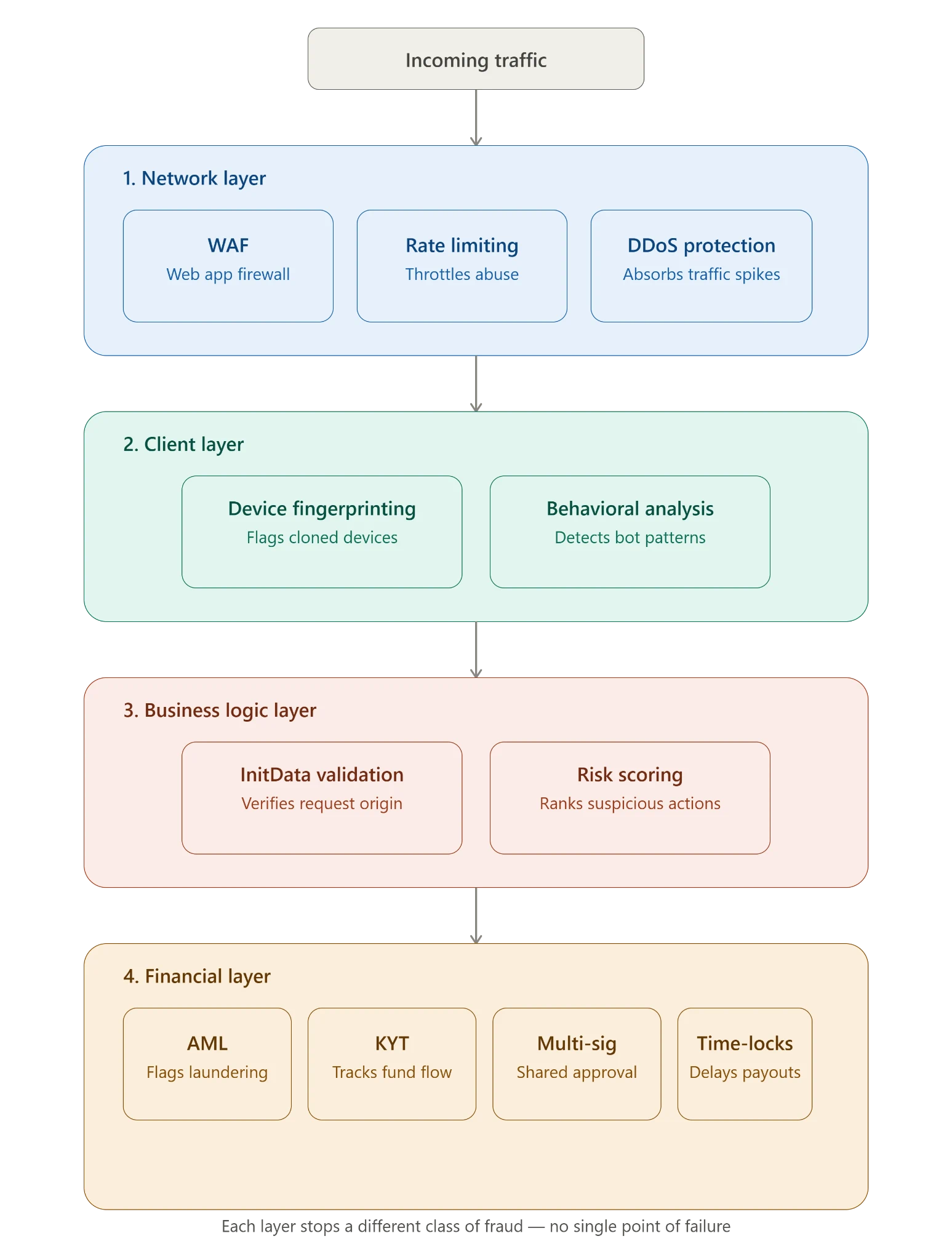
A. Device Fingerprinting and Behavioral Analysis
IP addresses can be easily changed through a proxy. We use Device Fingerprinting and behavioral analytics:
- Hashing of browser and hardware parameters (Canvas, WebGL, audio fingerprint).
- Mobile telemetry analysis: touch latency, swipe patterns, device orientation and accelerometer data. Automated emulators give themselves away as static and mathematically ideal intervals between taps.
B. Strict cryptographic validation on the backend side
Any data coming from the front end (including WebApp SDK, mobile applications or web forms) is considered potentially hostile.
- Signature Authentication: All session and initialization data must be validated on the backend using HMAC-SHA256 and the server's private key.
- Anti-abuse API: Rate Limiting at the Redis level for each unique token and device ID.
V. Web3 & On-Chain Security: AML and KYT
For FinTech and Web3 projects, a clean history of incoming funds is critical.
- KYT (Know Your Transaction): Automatic scoring of incoming crypto addresses in real time. If the user’s wallet interacted with mixers (Tornado Cash), darknet markets or is under sanctions, the transaction is frozen until KYC is completed.
- Multi-Sig and Time-Locks: Large pools of funds and administrative functions of smart contracts are protected by multi-signature (3 of 5 keys) and a time-lock, which gives the team time to react if a hack is attempted.
3. Matrix of MonoSoftware anti-fraud tools
| Threat | Security Tool | Result of implementation |
|---|---|---|
| Bot farms / Emulators | Fingerprinting + Behavioral AI + Captcha Trigger | Cuts off up to 98% of automated traffic before accessing the database |
| Abuse of bonuses / Forks | Graph databases (Neo4j) for finding connections between accounts | Automatically block related meshes based on common patterns |
| Smart Contract Exploits | Formal verification, Reentrancy Guards, Time-locks | Eliminate reentrancy attacks and oracle manipulation |
| DDoS and spam API | Cloudflare Enterprise + Redis Rate Limiting | Guaranteed backend availability during attacks up to 1M+ RPS |
4. FinTech and Web3 product security checklist before launch
- Smart contract audit: Conducted independent static code analysis (Slither, Mythril) and external logic audit.
- API protection: All private endpoints require Request Signatures with a TTL nonce.
- Anomaly monitoring: Alerts have been set up for abnormal debits/withdrawals, a sharp increase in successful bets or instant withdrawal of deposits.
- Hot wallet isolation: The bulk of funds are stored in custodial cold storage; The balances of “hot” wallets are replenished automatically according to limits.