Hybrid payment infrastructure combining traditional fiat acquiring and cryptocurrency transactions is the main trend in modern FinTech, Web3 and iGaming services. The ability to accept payments by bank cards (Mastercard, Visa), local payment systems (PIX, UPI, SEPA) and at the same time support stablecoins (USDT, USDC) or native tokens significantly increases the conversion of the first purchase and expands the geography of the project to the global market.
However, building such a system is not just about connecting a couple of third-party APIs. Architects have to solve the problems of minimizing network commissions (Gas), protecting against volatility, legal purity of funds and compliance with regulatory requirements (VASP, AML, Travel Rule). In this article, MonoSoftware experts examine the technical design and regulatory aspects of hybrid processing systems.
1. Hybrid processing architecture
When designing a payment module, it is necessary to isolate the user interface from direct work with blockchain nodes and acquiring providers through a flexible layer - Payment Orchestration Layer.
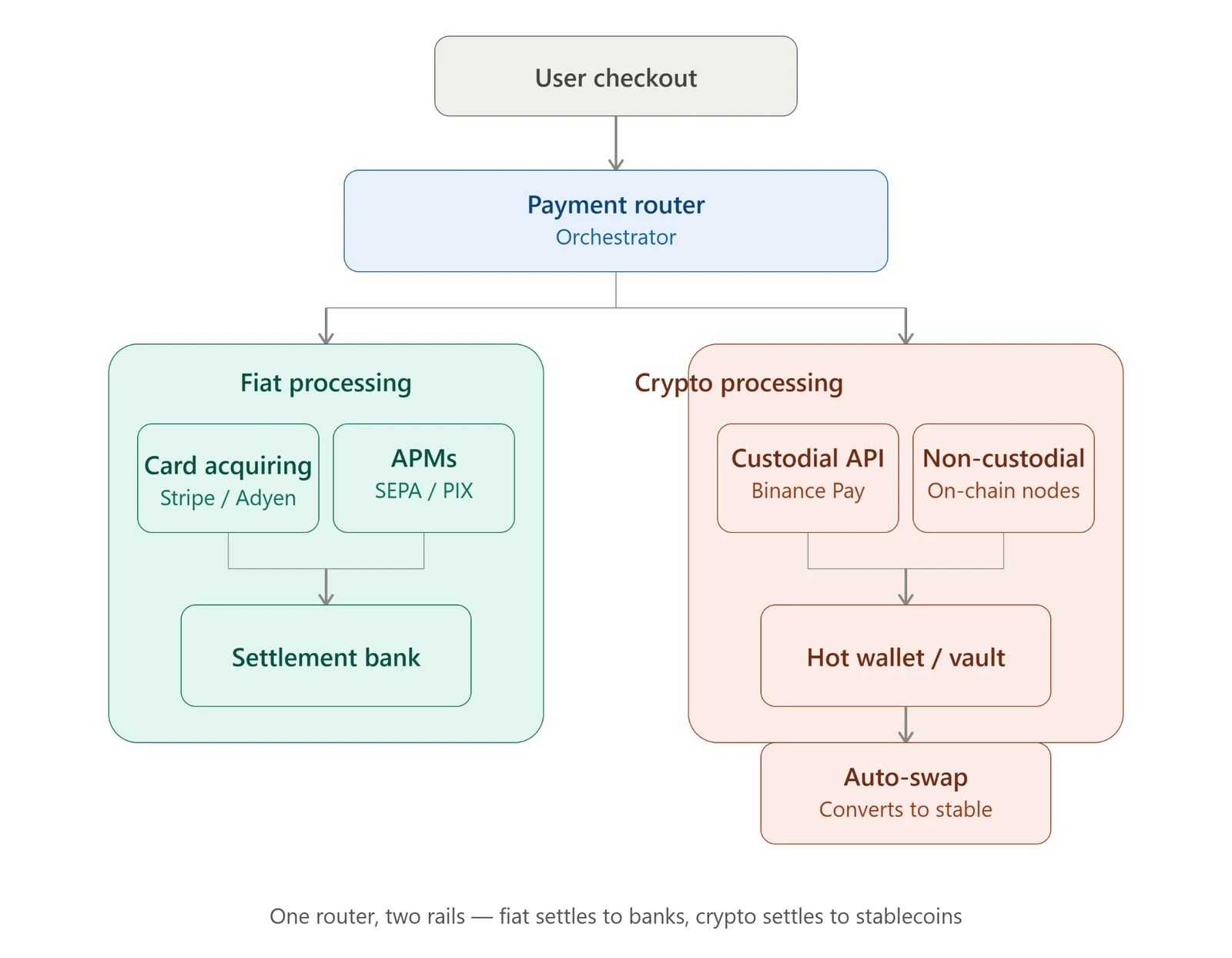
A. Fiat Processing
Connecting traditional channels requires the integration of several acquirers to provide redundancy (Fallback).
- Smart Routing: The system automatically selects the provider with the lowest commission and the highest percentage of successful transactions (AVS / 3D-Secure approval rate) for a specific country and card type.
- Tokenization: Card data never passes through your application servers. Uses secure iFrames or payment gateway SDKs that comply with the PCI DSS Level 1 standard.
B. Crypto Processing
Depending on business requirements, cryptoprocessing is implemented according to one of two models:
- Custodial approach (Custodial / Merchant APIs): Using ready-made services (Cryptomus, CoinPayments, Binance Pay). Easy to integrate, but imposes service fees (0.5-2%) and risks of freezing funds on the provider’s side.
- Non-custodial approach (Self-hosted On-Chain Nodes): Generating unique addresses for each payment through HD wallets (BIP-32/44) or smart contracts. Funds come directly under the control of the company, eliminating the third-party risk of an intermediary.
2. Managing fees, volatility and liquidity
One of the main problems with accepting cryptocurrencies is the unpredictability of network commissions (Gas) and rate fluctuations during block confirmation.
A. Optimization of network commissions (Gas Management)
- L2 networks and fast blockchains: Transferring microtransactions to low-cost networks (TON, TRON, Solana, Arbitrum, Polygon) with a commission < $0.1.
- Gas Stations (Paymaster / TON Connect): Using Account Abstraction (ERC-4337) in EVM networks or commission sponsorship capabilities in TON Connect, when the seller pays for gas for the user in stablecoins.
- Batching: Background collection of incoming small amounts to the main wallet when network fees are lower.
B. Volatility Protection (Instant Auto-Hedging)
To avoid losses when the price of crypto assets falls:
- Fixed exchange rate at the time of payment: The user is given a window of 15-30 minutes with a fixed exchange rate.
- Automatic Conversion: Instantly exchange incoming volatile assets (BTC, ETH) for stablecoins (USDT/USDC) or fiat via the API of centralized exchanges (CEX) or DEX aggregators.
3. Compliance, VASP and Travel Rule
Legalization of hybrid payment flows requires strict work with the international regulatory field.
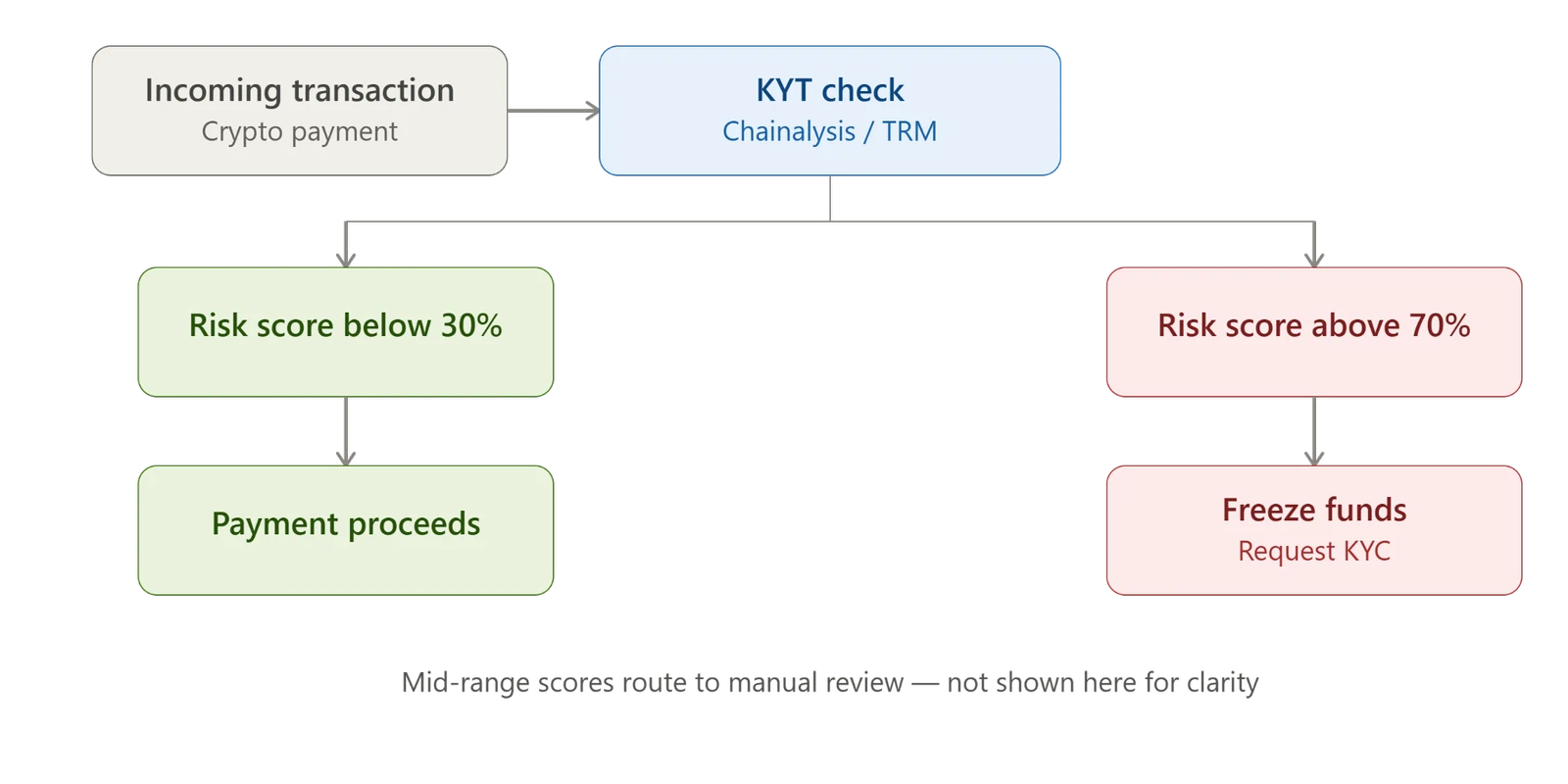
- Travel Rule (FATF): Mandatory exchange of information about the sender and recipient of funds between VASPs for transactions above $1,000 / €1,000.
- Fiat KYC (SumSub / Veriff): Automatic identity verification when fiat deposit/withdrawal amounts are exceeded.
4. Comparative analysis of processing approaches
| Parameter | Traditional Fiat | Custodial cryptoprocessing | Self-Hosted Non-Custodial |
|---|---|---|---|
| Acquiring fee | 2.5% - 5% + fixed fee | 0.5% - 1.5% + network gas | Network Commission Only (Gas) |
| Chargeback Risk | High (up to 54 days to dispute) | None (transactions are irreversible) | Missing |
| Settlement speed | T+1 ... T+7 days | Instant or T+0 | Instantly (at the time of block) |
| Compliance Difficulty | High (requires PCI DSS, Merchant Account) | Medium (delegated to provider) | High (requires its own VASP license) |
5. Checklist for readiness of the payment module for production
- PCI DSS / Tokenization: Client fiat payment data is isolated and does not reach application servers.
- Fallback routing: Configured to automatically change the acquirer in case of failure.
- Automatic KYT scoring: All incoming crypto transactions go through a filter to check the origin of funds.
- Liquidity imbalance monitoring: Alerts have been implemented to deplete balances on hot wallets for payouts or withdrawals.