Selling an IT product, raising a venture round A/B or an M&A deal is a process where the valuation of a company directly depends on the purity of its digital assets. Founders often focus on the Pitch Deck, forgetting about Tech Due Diligence and legal transfer of rights to the code (IP).
If during the audit process an investor discovers problems with code rights, dirty architecture or lack of documentation, the company's valuation may drop by 30-50%, and the deal itself may fall through. At MonoSoftware, we regularly help startups with pre-sales preparation. In this article, we will look at how to get the technical and product parts of the application in full order before going to investors.
1. IP Transparency and Legal Assignment of Code Rights
The first thing the fund's lawyer and technical auditor checks is who owns the rights to intellectual property (Intellectual Property).
- Agreements with developers and contractors: Each commit in the repository must be closed with acceptance certificates and agreements on the transfer of exclusive rights (IP Assignment Agreements). If some of the code is written by freelancers without official documents, the investor will consider this functionality risky.
- Audit Open-Source Licenses: Using third-party libraries with strict licenses (eg GPL v3) can bind your entire commercial product to an open source obligation. All libraries must comply with commercial licenses (MIT, Apache 2.0, BSD).
- Trademarks and Domains: All rights to branding, domain names, store accounts (Apple Developer, Google Play) and trademarks must be registered in the legal entity (OpCo / HoldCo) that is being sold as part of the transaction.
2. Preparation of technical infrastructure and documentation
An investor buys not just an idea, but a working business mechanism that can be transferred to a new team without loss of performance.
Important: A project is considered ready for M&A only when a third-party Senior engineer can deploy a working copy of the entire system in a new cloud in 1-2 days, using only existing documentation.
- Architectural documentation (Architecture Blueprint): Microservice interaction diagrams, API descriptions (Swagger/OpenAPI), database structures and payment flow logic.
- Automation of CI/CD and IaaC (Infrastructure as Code): Server deployment should occur automatically through scripts (Terraform, Ansible), and not by an engineer in the console. This guarantees the absence of dependence on the human factor (Key Person Risk).
- Results of external security audits: Having up-to-date reports on security audits (Penetration Testing) and smart contract verification (if the product is associated with Web3) significantly increases investor confidence.
3. Product analytics and measurable unit economics
The investor buys metrics and their scaling potential. Data should be compiled into transparent cohorts and confirmed by independent analytics systems (Mixpanel, Amplitude, AppsFlyer).
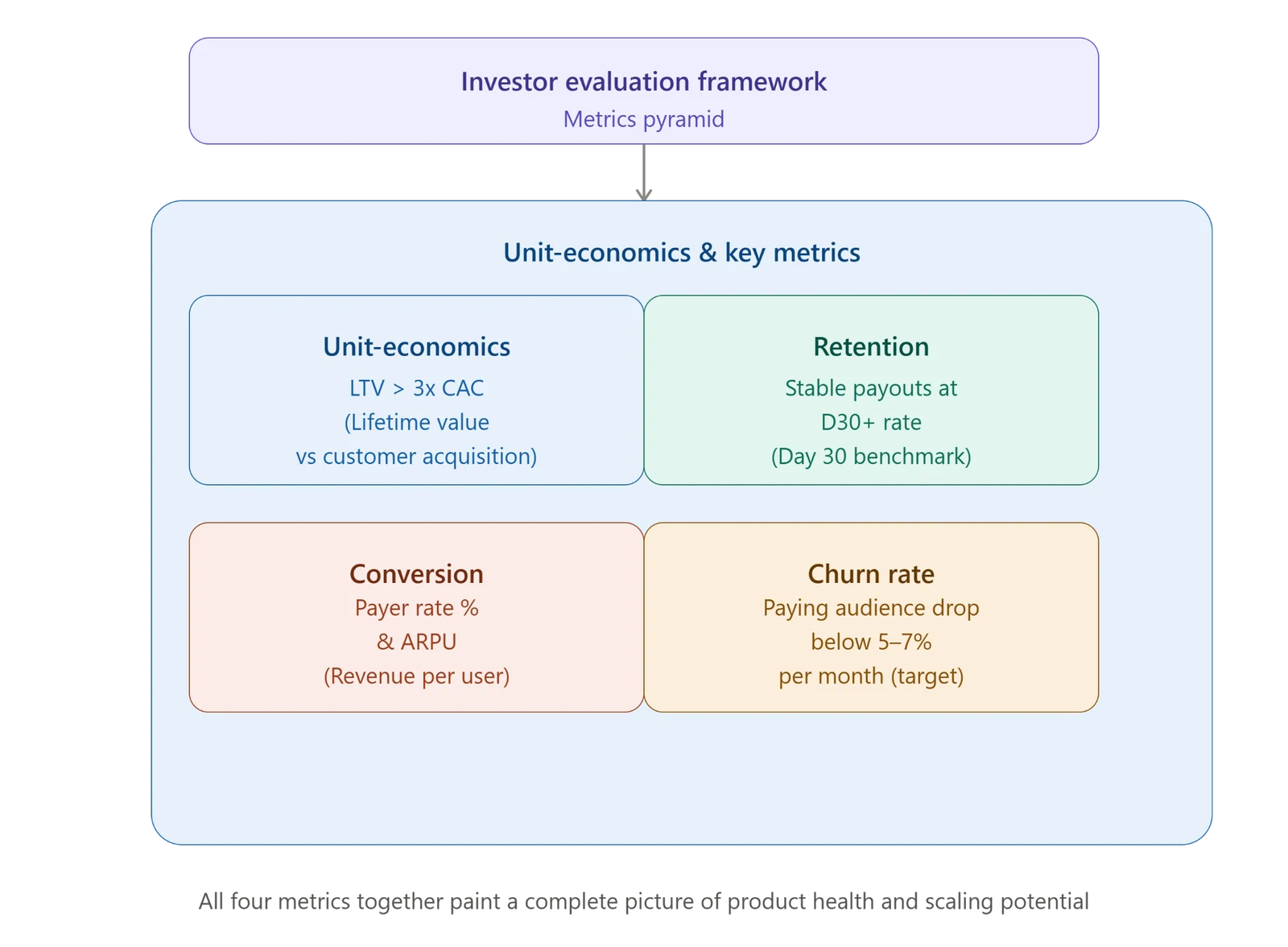
- Proven LTV/CAC: Customer acquisition cost should be at least three times lower than the profit a user generates over their lifetime ($LTV > 3 \times CAC$).
- Formation of a Retention plateau: The user retention graph (D1, D7, D30) should reach a horizontal plateau, confirming the presence of Product-Market Fit (PMF).
- Purity of organics and advertising traffic: No gluing of bot traffic. The audience should be segmented by sources, geo-locations and paying ability.
4. Matrix of product readiness for an investment round
| Direction | What does an investor check? | Risk of Lack of Preparation |
|---|---|---|
| IP Rights | Contracts, transfer of rights, no GPL risks | Freezing the deal until the rights are purchased from the code authors |
| Codebase | Test coverage, readability, no hardcode | Discount to company valuation (up to 30%) for code rework |
| Infrastructure | Auto-deployment (CI/CD), backups, monitoring | Risk of system crash when transferring rights to a new team |
| Analytics | Cohort analysis, end-to-end unit economics | Inability to confirm true financial LTV |